Chairman Moolenaar, Ranking Member Khanna, and distinguished members of the committee, thank you for the opportunity to testify on the U.S.-China artificial intelligence (AI) competition.
China is pursuing a full-stack approach to AI development, from chips and compute infrastructure to foundation models and applications. The goal of Chinese policymakers is not to achieve AGI, or “artificial general intelligence,” but to leverage AI as a powerful, general-purpose technology that will turbocharge a wide range of sectors and services. National programs, such as China’s 2017 New Generation AI Development Plan and its more recent “AI Plus” Initiative, are geared toward integrating AI into manufacturing, health care, drug discovery, scientific research, education, and government services. China’s military and security agencies have long sought to use AI to improve both defensive and offensive capabilities.
China’s top AI models continue to lag behind American frontier models by several months or more. American AI models maintain a clear lead in overall performance across a wide range of industry benchmarks, from math and reasoning to code generation and long-horizon agentic tasks. Chinese AI labs, particularly startups, are constrained by access to compute, due to a combination of U.S. export controls on advanced AI chips and limited capital resources. Alibaba, one of China’s largest AI players, plans to invest over $53 billion in AI over three years. In contrast, Microsoft spent approximately $80 billion on AI capital expenditures in 2025 alone. America’s main hyperscalers—Alphabet, Amazon, Meta, and Microsoft—have plans to spend a total of $650 billion just this year. American data centers are reaching gigawatt scales and deploying hundreds of thousands of AI accelerators. If everything boiled down to compute and the race to AGI, the United States would hold the decisive advantage.
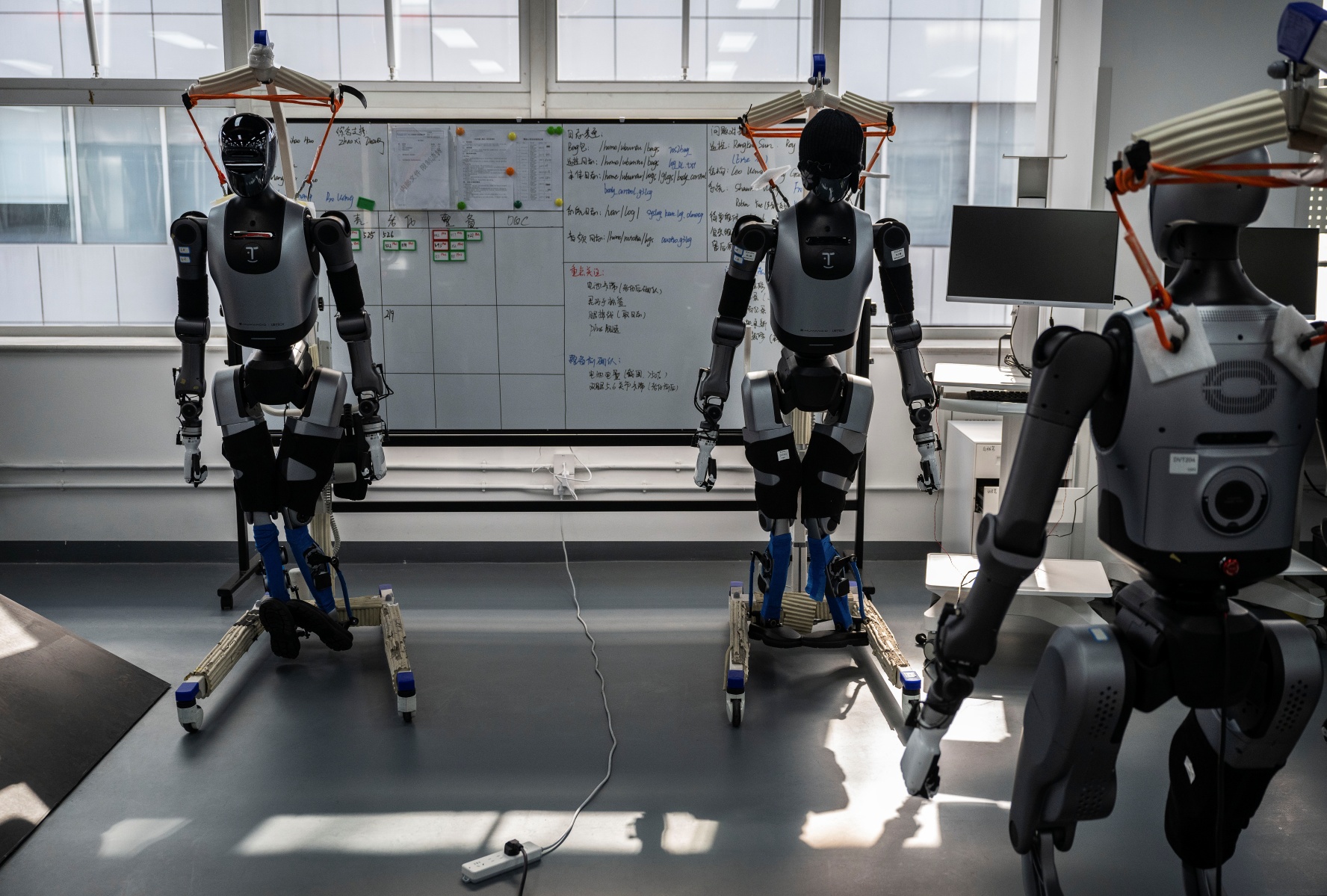
But China is pursuing a different approach to AI. While some Chinese AI companies, such as DeepSeek and Alibaba, also talk about trying to achieve AGI, Chinese policymakers and China’s AI industry as a whole are more focused on running several different AI races. They are more focused on making progress in model efficiency, AI adoption, and the integration of AI into the physical world. China’s focus on these dimensions of AI development is the result of several factors, including industry constraints—particularly access to large-scale compute and capital—as well as Beijing’s policy priorities. In addition, China is aggressively pursuing semiconductor self-sufficiency, seeking to localize nearly every major segment of the semiconductor supply chain in the face of U.S.-led export controls.